Iranian-American playwright Sanaz Toossi explores belonging and identity in the liminal space between cultures, in her 2023 Pulitzer Prize winning play, English.
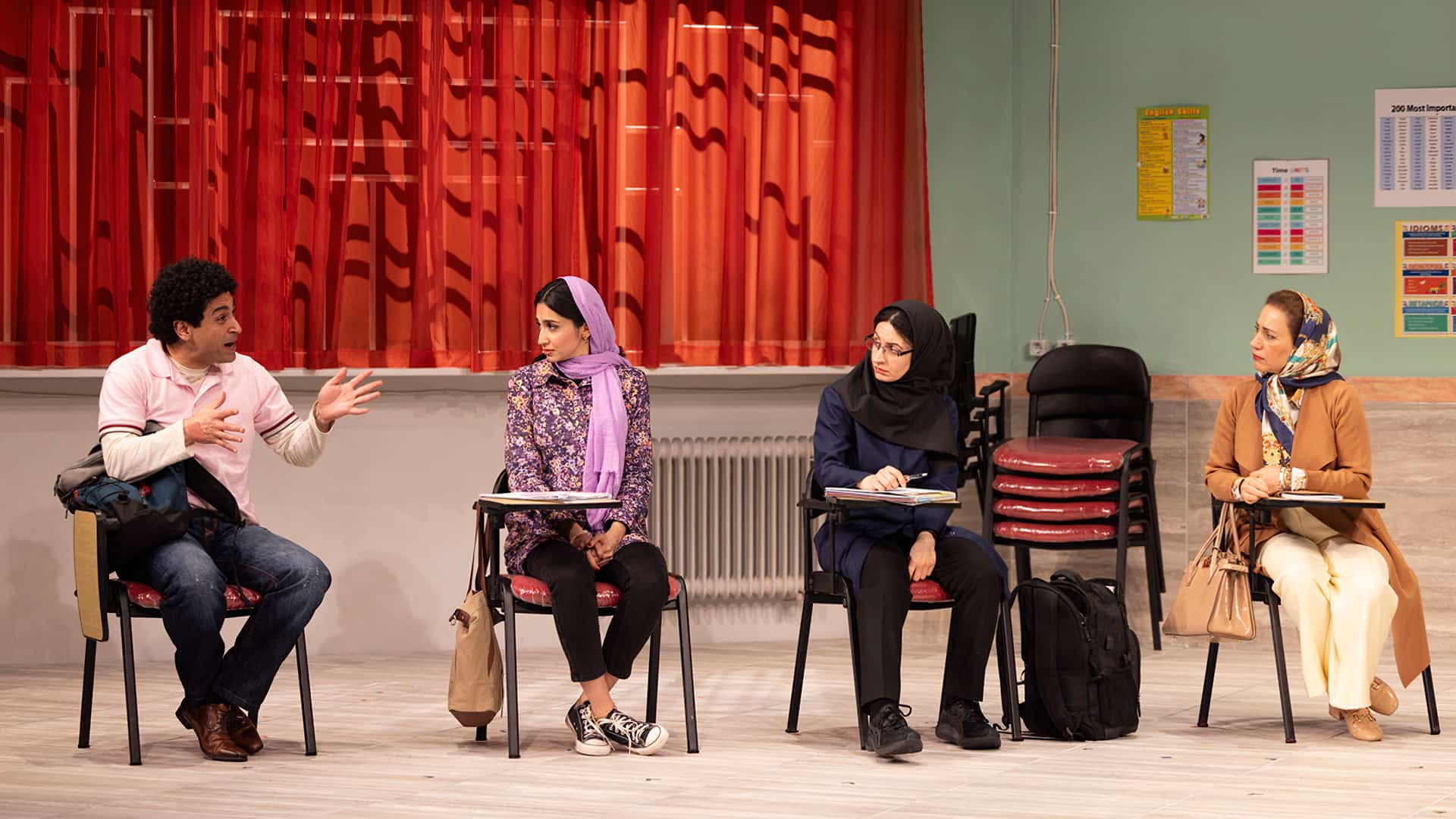
Set in a language learning centre in Iran, four adult students are preparing to undertake their TOEFL (or Test of English as a Foreign Language). The teacher, Marjan (Salme Geransar), sets the ground rules early, writing on the white board in large letters – “English Only”. Underline. “In this room, we are native speakers,” she tells her students. “We think in English. We laugh in English.”
As the play unfolds, we discover that each of the characters has their own reason for wanting, or needing, to learn English. For some, they hope it will open a door to another world of greater opportunities. But for others, it comes to represent the exact opposite. The prospect of potentially moving to another country, immersed in a language and culture far from their own customs and values, forces them to consider what they might be giving up or leaving behind.
The teacher, Marjan, is originally from Iran, but has recently returned from England where she has lived for the past nine years. While the reason for her return is never fully explained, it’s clear she has left (at least part of) her heart in the west. She strikes up a friendship with the only male student in the class, Omid (Osamah Sami) who emerges as a possible love interest, and together they enjoy watching Hugh Grant rom-coms as a way to practise their language skills, and to spend time in each other’s company. Omid, as it turns out, is already practically fluent in English, having been born in the US and spent much of his childhood there, but is keen to erase his Iranian voice. Now, as an adult male, he has plans to return to the States, but he fears his foreign accent will single him out for unwelcome attention.
Roya (Marjan Mesbahi) has a son and grandchild in Canada, and is making plans to relocate to be near them. However, her son (who we only hear from indirectly) has made it clear he intends to raise his child as a westerner, and insists that Roya learns to speak English fluently before she can be part of her grandchild’s life. Roya fears she will be unable to communicate her authentic self in a foreign language, and questions what she is being asked to put aside, in order to comply with her son’s wishes.
Elham (Maia Abbas) has an invitation to go to Australia to undertake further study, but needs to pass her TOEFL before the offer expires. For the combative and competitive Elham, learning English is a symbol of the dominance of western culture, but a necessary evil if she is to pursue her chosen career. And finally – as if to prove the point – Goli (Delaram Ahmadi), the youngest of the students, is attracted by the glamourous west, citing Ricky Martin lyrics as evidence of it's superiority and sophistication.
While the actors do technically speak English throughout, in the world of the play, the characters frequently break the golden rule by switching between English and their native Farsi, earning negative brownie points every time they do so. In a neat convention established early on, the two languages are distinguished by the actors adopting ‘Aussie’ accents whenever they speak Farsi, but revert to a heavily accented, more formal, halted tone when speaking in English. It's a clever device, and underscores the point that the characters feel more relaxed, more articulate, speaking in their native tongue. When forced to speak in their not-quite-perfect English however, they often feel misunderstood, self-conscious and unable to be themselves. As one of the characters laments, no-one finds them funny when they speak in English – it's hard to crack a joke in your second language.
According to the Director’s notes, English is set in 2008, although little in the dialogue would seem to indicate (or indeed require) that. Certainly the broader political reality of Iran in the world outside the classroom never really intrudes. Any questions over women’s rights or religious freedom under an ultra-conservative regime are entirely absent from the discussion, but the writer is clearly interested in other matters. Throughout the course, each of the characters confronts their own personal dilemma (or not), but there are to be no glib rom-com endings, leaving much unresolved.
Director Tasnim Hossain has coaxed solid if somewhat restrained performances from the entire cast, with all but one (Sami) making their MTC debut. Simply but effectively staged, the set (Kat Chan) consists of a single classroom, sparsely furnished with a few chairs, a whiteboard and a clock on the wall that changes with every scene to represent the passing of time.
This is a sweet play, which gently explores complex feelings of culture and belonging, which will no doubt resonate with many. With English, MTC have sought to bring a host of new voices and faces to the stage, and in that they have succeeded. While it is unlikely to be accused of being ground-breaking, English is nonetheless a thought-provoking and enjoyable production.
Event details
Melbourne Theatre Company presents
English
by Sanaz Toossi
Director Tasnim Hossain
Venue: The Sumner | Southbank Theatre, Southbank VIC
Dates: 29 July – 29 August 2024
Bookings: www.mtc.com.au